Engineered Science期刊第3期論文已正式在線出版
http://www.espublisher.com/allIssues.html?linkCode=1101&journalId=1&volume=3
敬請各位專家學者多投稿、審稿,多瀏覽、下載和引用本期刊論文,也敬請您多提寶貴意見,以便我們后期進一步優化和改進本期刊質量,感謝您的大力支持!
1. Qinglong Jiang*, Wei Yu, Aboozar Mosleh, Chuntai Liu, Daoyuan Wang, Xin Tu, Yanan Liu, GrantWangila*, Stéphanie Ognier, Bingyang Cao, Zhanhu Guo and Brian J. Ewards*. Environment, Energy, Sustainability: Journal- ES Energy & Environment. Engineered Science, 2018, 3: 1-4.
2. Biao Zhao*, Jiushuai Deng, Rui Zhang*, Luyang Liang, Bingbing Fan, Zhongyi Bai, Gang Shao and Chul B.Park. Recent advances on the electromagnetic wave absorption properties of Nibased materials.Engineered Science, 2018, 3: 5-40.
3. Brian J. Edwards*, Aili Wang, Carl N. Edwards,and Hengbo Yin. Accuracy of the Single-mode Model of Controlled Release fromHollow Porous Nanospheres. EngineeredScience, 2018, 3: 41-47.
4. Mohammad Mahdi Tavakoli*, Daniel Prochowicz, PankajYadav, Rouhollah Tavakoli and Michael Saliba. Zinc Stannate Nanorod as anElectron Transporting Layer for Highly Efficient and Hysteresis-less PerovskiteSolar Cells. Engineered Science, 2018, 3: 48-53.
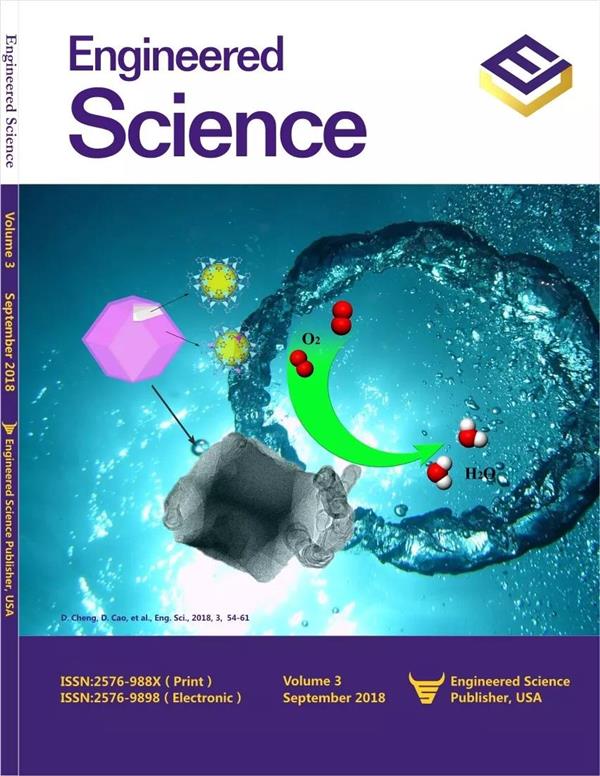
5. Haiyan Yu, Liu Yang, Daojian Cheng* and Dapeng Cao*. Zeolitic-imidazolate Framework(ZIF)@ZnCo-ZIF Core-shell Template-derived Co, N-doped Carbon Catalysts forOxygen Reduction Reaction. EngineeredScience, 2018,3: 54-61.
6. Lin Wei, Karen Lozano and Yuanbing Mao*. MicrowavePopped Co(II)-Graphene Oxide Hybrid: Bifunctional Catalyst for HydrogenEvolution Reaction and Hydrogen Storage. EngineeredScience, 2018, 3: 62-66.
7. Meng Zhang, Mengyao Dong, Shougang Chen*and Zhanhu Guo*. Slippery Liquid-infused PorousSurface Fabricated on Aluminum Maintain Stable Corrosion Resistance at ElevatedTemperatures. Engineered Science, 2018, 3: 67-76.
8. Xianmei Xiang, Fuping Pan and Ying Li*. Flower-likeBismuth Metal-organic Frameworks Grown on Carbon Paper as a Free-standingElectrode for Efficient Electrochemical Sensing of Cd2+ and Pb2+in Water. Engineered Science, 2018, 3: 77-83.
9. Chu Zhai, Hengbo Yin*, Aili Wang and Jitai Li. Isomerizationand Redistribution of 2,5-Dichlorotoluene Catalyzed by AlCl3 and IsomerizationThermodynamics. Engineered Science, 2018, 3: 84-88.
10. Xiaomin Li, Wen Zhao, Rui Yin, Xiaoshuai Huang, Lei Qian*. A Highly Porous Polyaniline-Graphene Composite Used forElectrochemical Supercapacitors.EngineeredScience, 2018, 3: 89-95.
Environment, Energy, Sustainability: Journal- ES Energy & Environment
Qinglong Jiang, Wei Yu, Aboozar Mosleh, Chuntai Liu, Daoyuan Wang, Xin Tu, Yanan Liu, Grant Wangila, Stéphanie Ognier, Bingyang Cao, Zhanhu Guo and Brian J. Ewards
Engineered Science, 2018, 3: 1-4
DOI: 10.30919/es8d746
Abstract:As human beings, we are an inseparable part of our global environment. Natural resources from the environment, including natural energy resources, play a key role in the development of human civilization; however, the global environment has not been managed well during the course of civilization. Therefore, one of the most important challenges for the world nowadays is to find applications that utilize sustainable and renewable sources of energy, such as solar cells, wind turbines, fuel cells, et al.
Recent advances on the electromagnetic wave absorption properties of Ni based materials
Biao Zhao, Jiushuai Deng, Rui Zhang, Luyang Liang, Bingbing Fan, Zhongyi Bai, Gang Shao and Chul B. Park
Engineered Science, 2018, 3: 5-40
DOI: 10.30919/es8d735
Abstract:Electromagnetic interference problems have become an increasing problem with the rapid development of wireless information technologies and electronic devices at high frequency ranges, and this has stimulated much attention. To tackle this challenge issue, the electromagnetic absorbing materials that can attenuate electromagnetic waves are urgently pursued. The desired absorbers should include high-efficiency absorption, wide dissipation band, low cost, and being lightweight. Due to high saturation magnetization and permeability at high GHz frequency, ferromagnetic Ni has been considered as a high efficiency electromagnetic absorption. However, the eddy current effect caused by high electrical conductivity, would limit the application. To tackle this problem, two effective ways including designing hierarchical structure and compounding are explored. This paper reviews the state-of-the-art research in the design of Ni based composites as electromagnetic absorption materials. The ultimate goal of these Ni based absorbers is to achieve the strong absorption, the broader effective absorption frequency. The coreshell, yolk-shell and hollow porous structures are introduced into Ni based composites (Ni-metal, Ni-polymer, Ni-semiconductor and Ni-carbon composites) to enhance the electromagnetic absorption properties. Particularly, combing with carbonaceous (CNTs or graphene), the Ni-carbon ternary or quaternary even more phases composite would be a target direction to design high-efficiency electromagnetic absorption capability.
Accuracy of the Single-mode Model of Controlled Release from Hollow Porous Nanospheres
Brian J. Edwards, Aili Wang, Carl N. Edwards, and Hengbo Yin
Engineered Science, 2018, 3: 41-47
DOI: 10.30919/es8d742
Abstract:The kinetics of diffusion-controlled release from hollow nanoporous spheres of varying thickness were recently investigated using classical mass transport theory. A new model, expressed in terms of a single diffusive mode, was developed to describe the time-dependent mass transport of a loaded chemical species through the nanosphere shell based on physically reasonable boundary and initial conditions, as well as an assumption of monotonicity during the approach to steady-state diffusive behavior. The purpose of this communication is to demonstrate the validity of these assumptions in the long-time limit and to estimate the error associated with the short-time transport. To this end, the kinetics of the single-mode model are compared with a full solution to the time-dependent diffusion equation obtained using numerical techniques, which demonstrates the utility of the single-mode model for all but the initial moments of the transport process. As a result, it is evident that the single-mode model, which expresses the diffusion of the solute from the nanospheres in terms of a single, universal time constant, is a valid approximate model for describing diffusion in these nanoporous systems for controlled release applications.
Zinc Stannate Nanorod as an Electron Transporting Layer for Highly Efficient and Hysteresis-less Perovskite Solar Cells
Mohammad Mahdi Tavakoli, Daniel Prochowicz, Pankaj Yadav, Rouhollah Tavakoli and Michael Saliba
Engineered Science, 2018, 3: 48-53
DOI: 10.30919/es8d749
Abstract:Careful engineering of the electron transfer layer (ETL) is a promising approach to improve the efficiency of perovskite solar cells (PSCs). In this study, we demonstrate the potential of using zinc stannate (Zn2SnO4, or ZSO from here) as ETL for the fabrication of highly efficient PSCs. ZSO was deposited on top of FTO glass as thin films and nanorod arrays using ultrasonic spray pyrolysis (USP) technique. Optical characterizations reveal that perovskite films deposited on such nanorod arrays of ZSO have a lower transmittance exhibiting better charge extraction properties compared to the planar ZSO thin films. The best ZSO-based device reached a power conversion efficiency (PCE) of 18.24% and a high current density of 23.8 mA/cm2 . Moreover, these devices showed a lower hysteresis index in compared to the ZSO planar based devices.
Zeolitic-imidazolate Framework (ZIF)@ZnCo-ZIF Core-shell Template-derived Co, N-doped Carbon Catalysts for Oxygen Reduction Reaction
Haiyan Yu, Liu Yang, Daojian Cheng and Dapeng Cao
Engineered Science, 2018, 3: 54-61
DOI: 10.30919/es8d729
Abstract:Exposure of the active sites directly determines the catalytic activity of porous carbon electrocatalysts for oxygen reduction reaction (ORR). How to maximally expose these active sites in as-synthesized carbons is still a great challenge. Here we propose an efficient strategy to maximally expose the active sites of porous carbon catalysts, in which we use core-shell ZIF-8@ZnCo-ZIF (op-ZnCo-ZIF) as a precursor to synthesize Co, N-doped carbon catalysts (op-ZnCo-950) by pyrolysis. The low boiling metal Zn in the core-shell template can serve as the activation agent to yield the micropores and mesopores, and the cobalt in the shell is therefore dispersed well in the surface of as-synthesized carbons during the pyrolysis. As a result, the resultant op-ZnCo-950 exhibits a relatively high catalytic activity towards ORR with a half-wave potential of 0.846 V (vs RHE), and the higher methanol resistance and better stability than 20% Pt/C. This work provides an efficient core-shell template strategy for synthesis of carbon catalysts with highly exposed active sites for electrochemical applications including ORR, hydrogen evolution reaction and oxygen evolution reaction.
Microwave Popped Co(II)-Graphene Oxide Hybrid: Bifunctional Catalyst for Hydrogen Evolution Reaction and Hydrogen Storage
Lin Wei, Karen Lozano and Yuanbing Mao
Engineered Science, 2018, 3: 62-66
DOI: 10.30919/es8d723
Abstract:In an effort to develop a multifunctional catalyst for hydrogen generation and adsorption applications, a facile and cost-effective microwave popping method was used to synthesize popped graphene oxide (PGO) and Co-PGO hybrid. Both samples have been explored and compared as hydrogen storage materials and as electrocatalysts for hydrogen evolution reaction (HER) for the first time. The loading of Co(II) species on the surface of the PGO enhanced the hydrogen storage capability of PGO from 0.04wt% to 0.08wt% as measured at 293K and 800 mmHg. Co-PGO is also acting as a better electrocatalyst for HER compared to the PGO counterpart.
Slippery Liquid-infused Porous Surface Fabricated on Aluminum Maintain Stable Corrosion Resistance at Elevated Temperatures
Meng Zhang, Mengyao Dong, Shougang Chen and Zhanhu Guo
Engineered Science, 2018, 3: 67-76
DOI: 10.30919/es8d732
Abstract:Material corrosion induced by temperature variations is one of the main threats to materials immersed in complex and changeable marine environments. Superhydrophobic surfaces (SHS) are promising for protecting the underlying metal from corrosion. However, temperature variations in underwater environments have hindered the practical application of SHS, thus, their corrosion protection ability is limited. However, slippery liquid infused porous surfaces (SLIPS) can compensate for the aforementioned defects of SHS. In this research, a kind of SLIPS was designed over aluminum for marine corrosion applications using a three-step procedure, consisting of anodization, fluorination and solvent exchange method. The as-prepared SHS and SLIPS were characterized with scanning electron microscopy (SEM), X-ray photoelectron spectroscopy (XPS) and wettability measurement, and their corrosion properties were investigated by electrochemical impedance spectroscopy (EIS). With the perfluorinated lubricant and aluminium oxide coating, the SLIPS presented high corrosion resistance (2.06 × 10⁹ Ω cm2) in a broad temperature range.
Flower-like Bismuth Metal-organic Frameworks Grown on Carbon Paper as a Free-standing Electrode for Efficient Electrochemical Sensing of Cd2+ and Pb2+ in Water
Xianmei Xiang, Fuping Pan and Ying Li
Engineered Science, 2018, 3: 77-83
DOI: 10.30919/es8d736
Abstract:In this work, a free-standing electrode composed of bismuth terephthalate metal-organic frameworks grown on carbon paper (BiMOF/CP) was successfully prepared by a facile one-pot hydrothermal method. Materials characterization revealed the formation of flower-like ultrathin nanosheets of BiMOF fully covering on the microfibers of carbon paper. The BiMOF/CP was applied in the electrochemical detection of Cd2+ and Pb2+ in water. The BiMOF/CP electrode exhibited superior sensing performance with a linear detection of Cd2+ and Pb2+ with low detection limits of 1.5 μg/L for Cd2+ and 2.7 μg/L for Pb2+, respectively. The significantly enhanced sensing performance compared to bare carbon paper is attributed to the 3D hierarchical architecture of BiMOF and increased number of exposed surface sites, facilitating the adsorption of metals ions and electron transfer. The prepared novel materials will contribute to the development of cost-effective electrochemical sensors for heavy metal detection.
Isomerization and Redistribution of 2,5-Dichlorotoluene Catalyzed by AlCl3 and Isomerization Thermodynamics
Chu Zhai, Hengbo Yin, Aili Wang and Jitai Li
Engineered Science, 2018, 3: 84-88
DOI: 10.30919/es8d738
Abstract:The isomerization and redistribution reactions of 2,5-dichlorotoluene (2,5-DCT) over Lewis acidic AlCl3 catalyst were investigated at the reaction temperatures ranging from 392.15 K to 452.15 K. 2,6- (3,5-, 2,4-, 3,4-, and 2,3-) Dichlorotoluenes (DCT) with the yields of ca. 5.6%, 9.6%, 16.2%, 3.3%, and 2.3% were formed via the isomerization reactions at equilibrium. Chlorobenzene (CB), dichlorobenzene (DCB), and dichloroxylene (DCX) with the yields of ca. 0.5%, 19.2%, and 20.4% were formed via the redistribution reactions. Valuable chlorinated aromatics, DCT, DCB, and CB, with a high total yield of ca. 57% were formed via the catalytic isomerization and redistribution of 2,5-DCT. The isomerization thermodynamics analysis revealed that the isomerization reactions were endothermic and the yields of isomers were slightly affected by the reaction temperature.
A Highly Porous Polyaniline-Graphene Composite Used for Electrochemical Supercapacitors
Xiaomin Li, Wen Zhao, Rui Yin, Xiaoshuai Huang, Lei Qian
Engineered Science, 2018, 3: 89-95
DOI: 10.30919/es8d743
Abstract:A polyaniline (PANI)-porous graphene (PGR) hybrid material with high capacitive performance was synthesized through electropolymerization of aniline on the PGR. The microstructure and morphologies of the PANI-PGR were characterized by field emission scanning electron microscopy, while electrochemical behaviors were measured by cyclic voltammetry and galvanostatic charge-discharge. The effects of aniline and PGR concentrations and polymerization cycles on electrochemical performances of the PANI-PGR were investigated. The results demonstrated that the prepared PANI0.05-PGR1.25-15 (0.05 M aniline, 1.25 mg·ml-1 PGR and 15 polymerization cycles) showed the highest specific capacitance of 1209 F·g-1 at 0.2 A·g-1. The specific capacitance of the obtained PANI-PGR was higher compared with other PANI materials, such as graphene (GR)-wrapped PANI nanofiber, single walled carbon nanotube/PANI, and GR-PANI nanoworm composites. The PANI0.05-PGR1.25-15 also displayed good cycle stability, retaining 92% of the initial capacitance after 1000 cycles of charge-discharge. The excellent capacitive properties were attributed to large specific surface area of the PGR and good pseudocapacitive properties of PANI.