110. (CJPS) Upcycling of Poly(butylene adipate-co-terephthalate) into Dual Covalent Adaptable Networks through Chain Breaking-Crosslinking Strategy
writer:Bin-Bo Wang, Rong Huang, Xin Wang, Tao Jiang, Yi Wang, Shuai Du, Fa-Lin Li, Jin Zhu and Song-Qi Ma*
keywords:PBAT, 動(dòng)態(tài)交聯(lián),
source:期刊
specific source:CHinese Journal of Polymer Science
Issue time:2024年
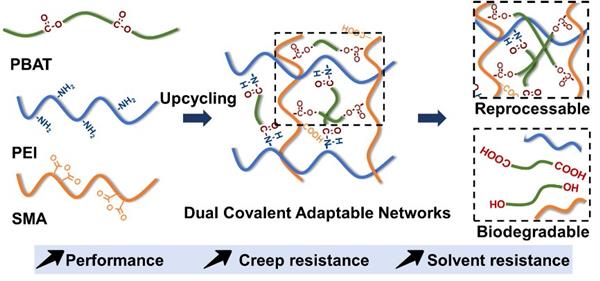
Poly(butylene adipate-co-terephthalate) (PBAT), a widely studied biodegradable material, has not effectively addressed the problem of plastic waste. Taking into consideration the cost-effectiveness, upcycling PBAT should take precedence over direct composting degradation. The present work adopts a chain breaking-crosslinking strategy, upcycling PBAT into dual covalent adaptable networks (CANs). During the chain-breaking stage, the ammonolysis between PBAT and polyethyleneimine (PEI) established the primary crosslinked network. Subsequently, styrene maleic anhydride copolymer (SMA) reacted with the hydroxyl group, culminating in the formation of dual covalent adaptable networks. In contrast to PBAT, the PBAT-dual-CANs exhibited a notable Young’s modulus of 239 MPa, alongside an inherent resistance to creep and solvents. Owing to catalysis from neighboring carboxyl group and excess hydroxyl groups, the PBAT-dual-CANs exhibited fast stress relaxation. Additionally, they could be recycled through extrusion and hot-press reprocessing, while retaining their biodegradability. This straightforward strategy offers a solution for dealing with plastic waste.
全文鏈接:https://link.springer.com/article/10.1007/s10118-024-3179-4#citeas