117. (Macromolecules) Synthesis and Properties of an Imidazole Urea-Coordination Dual-Dynamic Cross-Linked Latent Accelerator and Its Recyclable One-Component Epoxy Resin
writer:?Changhui Jing, Yihao Peng, Xin Wang, Fengyuan Zhang and Songqi Ma*
keywords:環(huán)氧樹脂,潛伏型促進(jìn)劑,動(dòng)態(tài)交聯(lián)
source:期刊
specific source:Macromolecules
Issue time:2025年
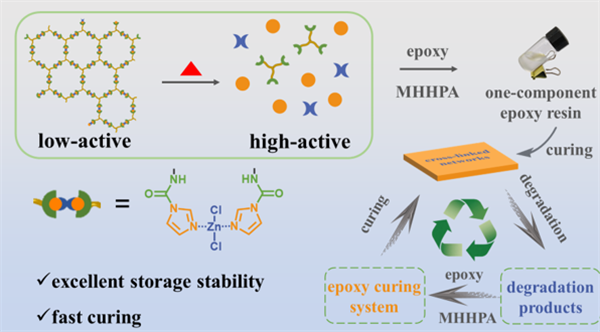
This work disclosed a novel latent accelerator and the first recyclable one-component epoxy resin. One-component epoxy resins with latent curing systems overcome the short pot life of conventional two-component epoxies; however, balancing storage stability and rapid curing remains challenging, and recyclability is still unmet. Here, we report a dynamic cross-linked latent accelerator (HMZ), synthesized via trimeric hexamethylene diisocyanate, imidazole (IM), and ZnCl2 and incorporated into a bisphenol A epoxy/methyl hexahydrophthalic anhydride (MHHPA) system to enable recyclable one-component epoxy resins. The dynamic cross-linked network through an imidazole–urea bond and Zn2+ coordination effectively fixed IM, suppressing ambient reactivity and ensuring >90 days of storage stability for the one-component epoxy system─markedly outperforming the IM system. Rapid curing at 120 °C (84% conversion within 45 min) was also realized due to the dissociation of the dynamic bonds and release of highly active imidazole. Critically, the cured epoxy/MHHPA/HMZ system can be degraded under mild conditions (50 °C, NaOH/acetone/H2O), and the recovered products serve as curing agents and accelerators in new epoxy formulations, enabling recycling and reusing. This work presents a simple and effective design for latent accelerators that simultaneously achieves high latency, fast curing, and full recyclability─advancing both epoxy technology and sustainable materials science for applications in coatings, adhesives, electronics, etc.
全文鏈接:https://pubs.acs.org/doi/abs/10.1021/acs.macromol.5c02046