Surface modification of poly(L-lacticacid) to improve its cytocompatibility via assembly of polyelectrolytes and gelatin
writer:YuanLin, Luling Wang, Peibiao Zhang, Xin Wang, Xuesi Chen, Xiabin Jing, Zhaohui Su
keywords:Poly(L-lactic acid); Electrostatic self-assembly; Gelatin; Chondrocyte; Cytocompatibility
source:期刊
specific source:Acta Biomaterialia, 2006, 2(2):155-164
Issue time:2006年
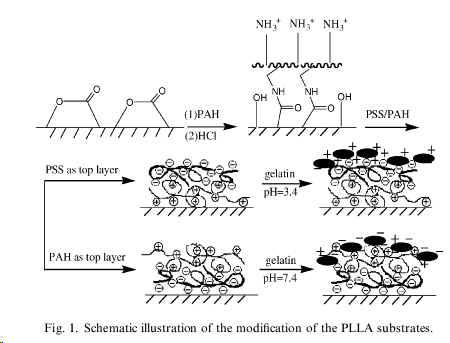
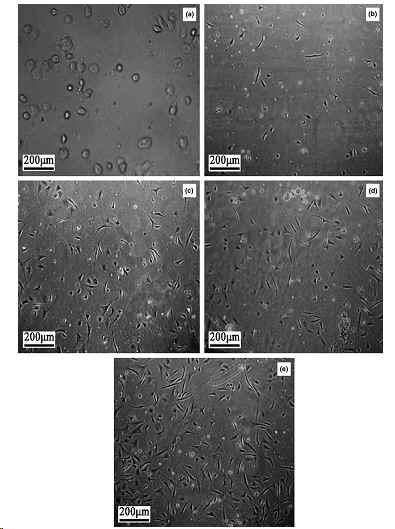
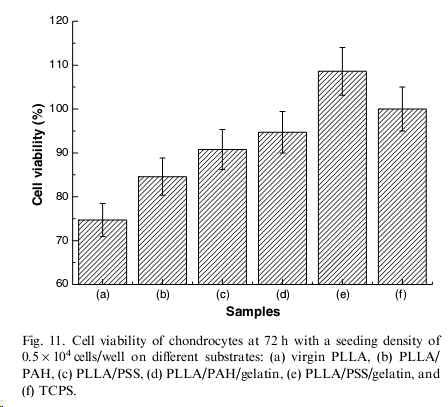
[Abstract]: Poly(L-lactide) (PLLA) surface was modified via aminolysis by poly(allylamine hydrochloride) (PAH) at high pH and subsequent electrostatic self-assembly of poly(sodium styrenesulfonate) (PSS) and PAH, and the process was monitored by X-ray photoelectron spectroscopy (XPS) and contact angle measurement. These modified PLLAs were then used as charged substrates for further incorporation of gelatin to improve their cytocompatibility. The amphoteric nature of the gelatin was exploited and the gelatin was adsorbed to the negatively charged PLLA/PSS and positively charged PLLA/PAH at pH=3.4 and 7.4, respectively. XPS and water contact angle data indicated that the gelatin adsorption at pH=3.4 resulted in much higher surface coverage by gelatin than at pH=7.4. All the modified PLLA surfaces became more hydrophilic than the virgin PLLA. Chondrocyte culture was used to test the cell attachment, cell morphology and cell viability on the modified PLLA substrates. The results showed that the PAH and PSS modified PLLA exhibited better cytocompatibility than virgin PLLA, and the incorporation of the gelatin on these modified PLLA substrates further improved their cytocompatibility, with the PLLA/PSS substrate treated with the gelatin at pH=3.4 being the best, exceeding the chondrocyte compatibility of the tissue culture polystyrene.
http://www.sciencedirect.com/science/article/pii/S1742706105001558