16.【J. Phys. Chem. C】Effects of Subphase pH and Temperature on the Aggregation Behavior of Poly(lauryl acrylate)-block-poly(N-isopropylacrylamide) at the Air/Water Interface.
writer:Kun You, Gangyao Wen*, Athanasios Skandalis, Stergios Pispas, Shicheng Yang, Hongfei Li, Zhaoyan Sun
keywords:LB film; block copolymer; PLA-b-PNIPAM; subphase pH; temperature responsiveness
source:期刊
specific source:J. Phys. Chem. C 2019, 123(16), 10435-10442.
Issue time:2019年
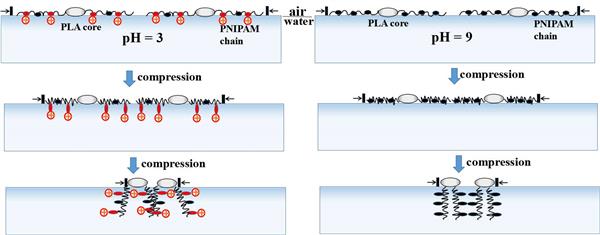
Effects of subphase pH and temperature on the aggregation behavior of a thermosensitive amphiphilic diblock copolymer poly(lauryl acrylate)-block-poly(N-isopropylacrylamide) (PLA-b-PNIPAM) at the air/water interface and the morphologies of its Langmuir-Blodgett (LB) films were characterized with the Langmuir film balance technique and atomic force microscopy, respectively. The surface pressure-molecular area isotherms shift positively with the increase of subphase pH and there exist two quasi-plateaus under acidic condition but only one under neutral or alkaline conditions. The lower and upper plateaus under acidic condition are attributed to immersion into water for the protonated amide groups and the rest of PNIPAM blocks, respectively. The plateau pressures gradually decrease with the elevation of temperature due to promotion of protonation and solubility of PNIPAM blocks. On the contrary, those under neutral and alkaline conditions gradually increase but exhibit a lower critical solution temperature behavior which is consistent with that of PNIPAM-containing polymers in aqueous solutions. The initial LB films of PLA-b-PNIPAM transferred from different subphases exhibit tiny isolated circular micelles which coalesce and transform into large dense ones upon compression. Furthermore, PLA cores usually coalesce with the elevation of temperature due to the increased molecular thermal mobility as a result of their low glass transition temperature.
Article address: https://pubs.acs.org.ccindex.cn/doi/10.1021/acs.jpcc.9b01320
Request link: https://pubs.acs.org/articlesonrequest/AOR-Dx6VGVDQGrKYXXy8EsAS