Effect of Surface Modification of Cellulose Nanocrystal on Nonisothermal Crystallization of Poly(β-hydroxybutyrate) Composites
writer:Jianxiang Chen, Defeng Wu, Kam C. Tam, Keren Pan, Zhigong Zheng
keywords:cellulose nanocrystal; surface modification; poly(β-hydroxybutyrate); crystallization; nucleation.
source:期刊
specific source:Carbohydrate Polymers
Issue time:2017年
Carbohydrate Polymers, 2017, 157C, 1821-1829.
ABSTRACT:
Ring-opening
polymerization of L-lactide from
cellulose nanocrystal (CNC) surface yielded polylactide-grafted CNC (CNC-g-PLA). The structure of as-obtained CNC-g-PLA was characterized by FT-IR, 1H
NMR, XPS and XRD. The crystallization behavior and lamellar structure of poly(β-hydroxybutyrate)
(PHB) in the presence of pristine CNC
and CNC-g-PLA was elucidated via DSC
and SAXS, and Babinet''''s reciprocity theory was applied. Crystallization kinetics were further analyzed
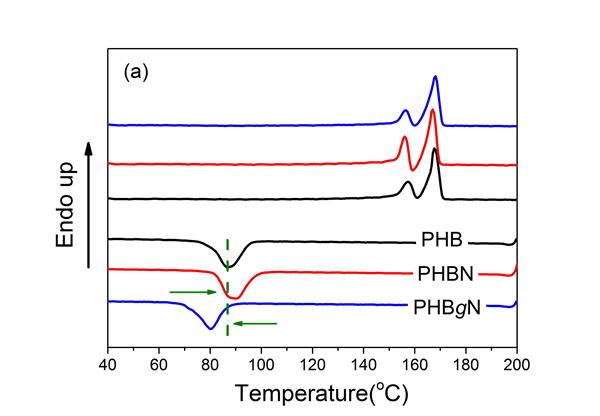
using Ozawa, Mo and Kissinger models. In the presence of pristine CNC, nucleation
of PHB crystals led to an increase in the crystallization temperature (Tc) of PHB; while CNC-g-PLA acted as antinucleation agent,
resulting in a remarkable reduction in Tc of PHB. Accordingly, the composite with pristine CNC possessed a higher
crystallization rate than neat PHB, while CNC-g-PLA displayed the lowest crystallization rate. However, the lamellar structure of PHB was not affected by the presence of
pristine and modified CNCs, and almost identical crystallization activation
energies as the neat PHB were observed, indicating that nucleation is dominant
during PHB crystallization, instead of crystal growth. This study offers a
promising approach of using pristine and modified CNCs to control the crystallization
of biodegradable aliphatic polyesters.
PDF DOWNLOAD:
http://www.sciencedirect.com/science/article/pii/S0144861716313455