- Prof. Dr. Sheng Zhang
- Beijing University of Chemical Technology
- Welcome to zhangshengfrml.polymer.cn
- Visits:1051610
Links
Contact Info.
- Address:北京市朝陽區(qū)北三環(huán)東路15號2號信箱
- Zip:100929
- Tel:010-64436820
- Fax:010-64436820
- Email:[email protected]
Current Location :> Home > Publications > Text
Preparation and characterization of chitosan derivatives and their application as flame retardants in thermoplastic polyurethane.
writer:劉曉東,谷曉昱,孫軍*,張勝*,
keywords:chitosan derivatives ;thermoplastic polyurethane;Preparation and characterization
source:期刊
Issue time:2017年
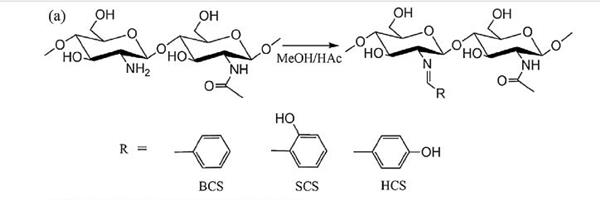
Our previous work has demonstrated that chitosan (CS) can be directly used as charring agents. In this paper, efforts were made to further improve the thermal stability and charring ability of CS by reacting with benzaldehyde, salicylaldehyde and hydroxybenzaldehyde respectively to obtain different CS derivatives. CSderivatives in association with ammonium polyphosphate (APP) was then introduced into thermoplasticpolyurethane (TPU) to prepare flame retardant TPU composites. The sample containing 18.75% APP and 6.25% salicylaldehyde modified CS (SCS) achieved the maximal limiting oxygen index of 29.5%, passed the V-0 rating and significantly decreased the peak heat release rate from 840.8 kW/m2of neat TPU to 206.2 kW/m2. Thermogravimetric analysis and char morphology observation demonstrated that SCS/APP could promote the char formation to form more intact intumescent char structure. It was proposed that the synergism between CSderivatives and APP might be responsible for the improvement of flame retardancy.
keywords:chitosan derivatives ;thermoplastic polyurethane;Preparation and characterization
source:期刊
Issue time:2017年
Our previous work has demonstrated that chitosan (CS) can be directly used as charring agents. In this paper, efforts were made to further improve the thermal stability and charring ability of CS by reacting with benzaldehyde, salicylaldehyde and hydroxybenzaldehyde respectively to obtain different CS derivatives. CSderivatives in association with ammonium polyphosphate (APP) was then introduced into thermoplasticpolyurethane (TPU) to prepare flame retardant TPU composites. The sample containing 18.75% APP and 6.25% salicylaldehyde modified CS (SCS) achieved the maximal limiting oxygen index of 29.5%, passed the V-0 rating and significantly decreased the peak heat release rate from 840.8 kW/m2of neat TPU to 206.2 kW/m2. Thermogravimetric analysis and char morphology observation demonstrated that SCS/APP could promote the char formation to form more intact intumescent char structure. It was proposed that the synergism between CSderivatives and APP might be responsible for the improvement of flame retardancy.