Biocompatible or biodegradable hyperbranched polymers: from self-assembly to cytomimetic applications
作者:Jin, H. B.; Huang, w.; Zhu, X. Y.; Zhou, Y. F.*; Yan, D. Y.
關(guān)鍵字:Biocompatible, biodegradable, hyperbranched, self-assembly
論文來(lái)源:期刊
具體來(lái)源:Chem. Soc. Rev. 2012, 41, 5986. http://pubs.rsc.org/en/content/articlelanding/2012/cs/c2cs3513
發(fā)表時(shí)間:2012年
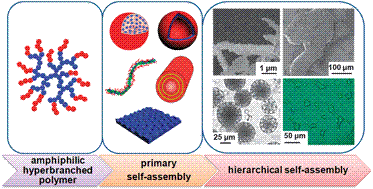
Self-assembly of amphiphilichyperbranched
polymers(HBPs) is a newly emerging research area and has attracted
increasing attention due to the great advantages in biomedical applications.
This tutorial review focuses on the self-assembly of biocompatible or
biodegradable amphiphilic HBPs and their cytomimetic applications, and
specialities or advantages therein owing to the hyperbranched structure have
also been summarized. As shown here, various supramolecular structures including
micelles, vesicles, tubes, fibers and films have been prepared through the
primary self-assembly processes. The primary self-assemblies can be further
assembled into more complex structures through hierachicalself-assemblyprocesses. Besides, thehyperbranched polymervesicles have demonstrated great
potential to be used as model membranes to mimic cellular behaviors, such as
fusion, fission and cell aggregation. Other biomedical applications of HBPs as
well as their self-assemblies are also briefly summarized.